
In the gripping finale of "Until I Kill You," titled "Justice," the long-awaited reckoning for John Patrick Sweeney's heinous crimes unfolds in a courtroom drama that tests the limits of Delia Balmer's strength and resilience. Seven years after the brutal attack that changed her life, Delia stands before the court to recount the harrowing night in vivid detail, her rapid speech belying the depth of her trauma.
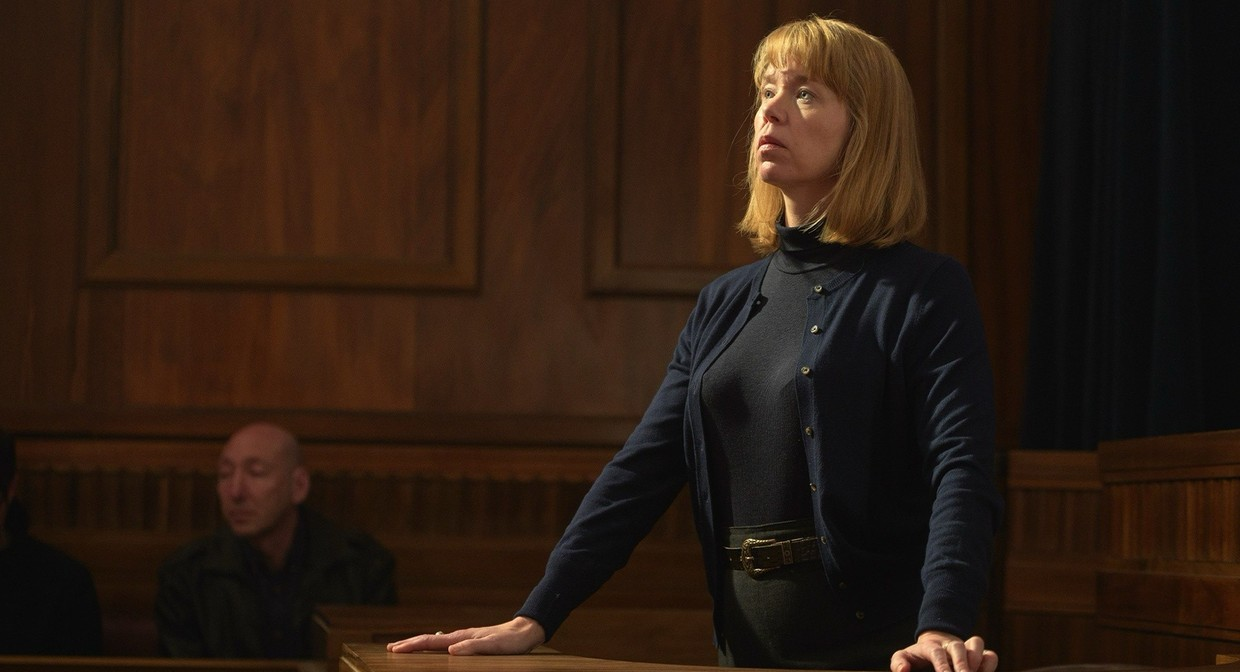
Delia's testimony is a powerful narrative of survival, painting a stark picture of the violence she endured at the hands of Sweeney. Her memory, sharp and unyielding, captures every nuance of that fateful night, a testament to the indelible mark it has left on her psyche. However, as the opposition begins their questioning, Delia's composure falters under the scrutiny of her relationship with Sweeney, particularly her refusal to accept police protection, which they use to cast doubt on her credibility.
In contrast, Sweeney maintains a chilling composure during his testimony, leveraging Delia's grudge against him to discredit her accusations. He dismisses Joshua Wilson's eyewitness account as a case of mistaken identity and, while admitting to the artwork that incriminates him, shows no remorse. His agitation only surfaces when confronted with the evidence that cannot be denied, a testament to his manipulative nature.
The judge's instructions to the jurors set the stage for a tense waiting game, the weight of the decision hanging in the balance. After a grueling 9 hours and 40 minutes of deliberation, the jurors return with a unanimous guilty verdict, a moment of triumph that is marred by Sweeney's ill-grace at the announcement.
Despite the verdict, Delia's life takes a turn for the worse when a local paper publishes an article featuring Sweeney's drawings, exacerbating her fears of public ridicule. David's assurances fail to quell her unease, and the revelation that Sweeney is eligible for parole after only nine years sends her into a tailspin. Fueled by outrage, Delia embarks on a campaign to prevent the courts and police from mistreating other victims, starting with a letter to Police Commissioner John Stevens. However, the impersonal response only deepens her sense of isolation and frustration.
Delia's crusade continues amidst David's increasing alcohol consumption, and their relationship reaches a breaking point during a dinner where David confronts her about her testimony of never loving anyone. The ensuing argument leads to Delia's arrest for drunken disorderly conduct, a humiliating low point that sees her released with an apology the next morning.
The couple's final argument culminates in Delia ending their relationship, a decision she regrets in solitude. Two years later, Delia redirects her focus towards work, volunteering as a therapeutic masseuse in the HIV ward and reconnecting with Nabil, a patient who shares her love for biking.
In Amsterdam, the investigation into the unsolved murder of Paula Fields takes a turn when DI Steve Smith receives news that Melissa Halstead's remains have been identified. The striking similarities between the cases of Melissa and Paula, both of whom had connections to Sweeney, ignite a race to link him to the crimes before he becomes eligible for parole.
The prosecution's case hinges on Delia's testimony, but her reluctance to get involved is evident. Steve and DC Ruth Croft face an uphill battle as they search for evidence to link Sweeney to the murders, with Delia's claim that he confessed to her being their only tangible connection.
When the judge refuses to admit taped testimony as evidence, Delia's live testimony becomes crucial. Her continued refusal leads to a medical examination, where Dr. Larence Howes helps her confront the painful memories of her attack. The session reveals the profound impact of her family, particularly Stewart Balmer, on her will to survive.
Ultimately, Delia's medical exemption allows the prosecution to share her testimony with the jury, leading to Sweeney's conviction and two life sentences without the possibility of parole. The series concludes with Delia renewing her passport and resuming her travels, a symbol of her regained freedom and a dedication to the memory of Melissa Halstead and Paula Fields, whose stories are now forever intertwined with her own.
"Justice" is a fitting finale to "Until I Kill You," offering a sense of closure while acknowledging the ongoing struggle for survivors of violence. It is a powerful reminder of the resilience of the human spirit and the importance of seeking and fighting for justice.